By Patty Sheats
VA Medical Center
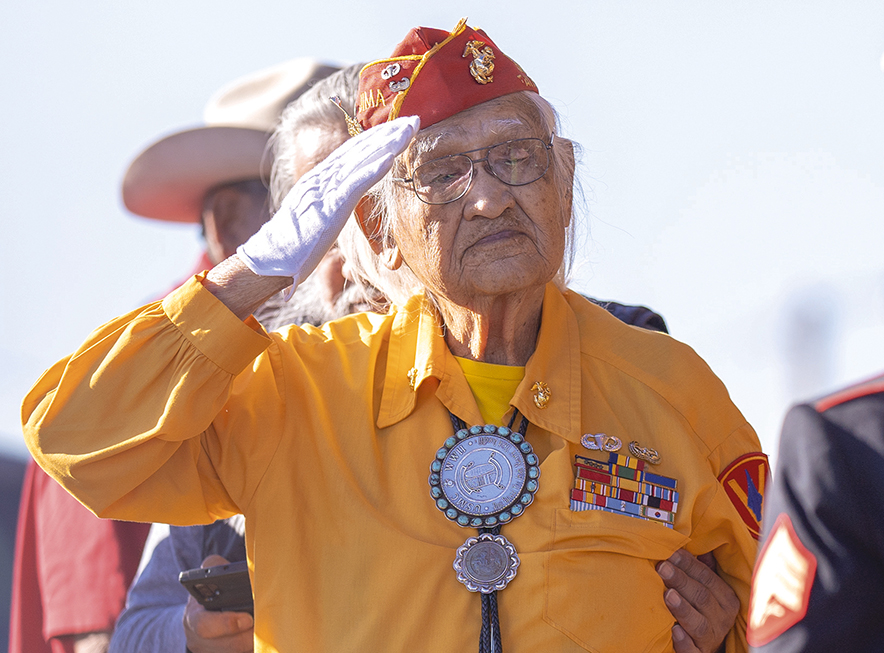
With the recent passing of one of the last Navajo Code Talkers John Kinsel, Sr, we’re presented with an opportunity to reflect on the legacy and impact of the legendary group of Marines that secured unbreakable code to secure communications abroad between 1942-1945.
These 400 indigenous men secured a place among the greats in US history. Their linguistic skills in English and Navajo were instrumental in in securing victory for the allied forces during a time when secure communication was difficult. One broken code could mean giving up the location of your men behind enemy lines.

(Images courtesy of the National World War II Museum)
The Birth of a Code
In 1942, the US Marine Corps sought to develop a way to communicate securely in the Pacific Theatre. The Navajo Language is rich, complex and a not known abroad. Therefore men were recruited from the Navajo Nation in Arizona, New Mexico and the 4 corners of Colorado. These brave men created a unique lexicon of words and alphabet, using code words for military objects in their language. For example, “turtle” represented a tank, “buzzard” stood for bomber and “iron fish” was code for submarine. Code talkers worked as pairs, one operating the radio and the other relaying the message in Diné (the Navajo language), and translating to English to command.
Not only was this system of code successful and unbreakable, it was also very fast; only taking a few minutes to encode and decode; crucial for combat settings-unlike the Axis codes taking manual effort, and significant time to decode.
Impact
The ability to send quick and undecipherable messages over enemy lines meant that allied powers could get critical information about troop movement, supply needs, wounded soldiers was vital for many battles in WWII. Without the Navajo code talkers, many historians agree we would have never won at Iwo Jima. Other important battles that were won in part by these Indigenous Marines were the Battle of Guadalcanal and Utah Beach during D-Day

Legacy
Despite their impact on the war effort, their contributions were unknown and classified for decades. These brave men were told they are not allowed to discuss their communication, service to anyone. In 1968 the actions of the Navajo Code Talkers (as well as the other 14 nations of indigenous men who were code talkers) were declassified. In 2001, the Code Talkers were awarded with valor and given the Congressional Gold Medal for their bravery and dedication.
Today we remember the Code Talkers and mourn the slow marching of time that is claiming these men’s stories. Their story reminds us of the resilience of the Indigenous Nations and the collective drive to continue talking about their legacy. May John Kinsel Sr. rest in peace.
National World WWII Museum Website